Our research activity focuses on the development of theory and algorithms for the calculation of molecular properties and molecular spectra of systems embedded in external complex environments based on the first principles of quantum mechanics.
- Development of Fully Atomistic Embedding Approaches for Computational Spectroscopy of Aqueous Systems
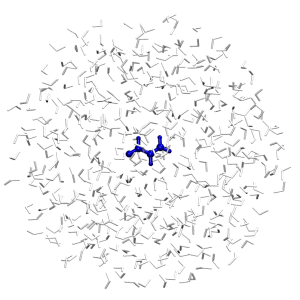
We focus on the development and implementation of fully polarizable multiscale QM/MM approaches for the calculation of molecular properties and spectroscopies of systems embedded in external environments. Chem. Soc. Rev. 2020, Chem. Commun. 2023, ACS Phys. Chem. Au 2022.
Our models have been applied to DFT Hamiltonians, however they go beyond QM single reference methods JCTC 2024, JCTC 2026, JCTC 2026-1.
Among the various properties/spectra whihc can be modelled, special emphasis has been given to chiroptical properties J.Phys. Chem. Lett., 2016; J. Chem. Theory Comput., 2013
Our methods are implemented in AMS, eT, OpenMolcas.
Development of Fully Atomistic Approaches for Modeling the Optical Response of Plasmonic Substrates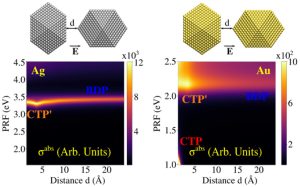
We develop fully atomistic classical models capable of describing the optical properties in the frequency domain of plasmonic substrates such as graphene or metal nanoparticles. Our models prove to be reliable against ab-initio results. Moreover, the affordable computational cost of our models, allows us to apply them to realistic-sized structures, still retaining a full atomistic description of the system.
For more details see NanoLett 2025; Comput. Phys Commun, 2026; ACS Photonics, 2022; J. Phys. Chem. Lett., 2020; Nanoscale, 2019. Our method is implemented in plasmonX .- Development of QM/Atomistic Frameworks for Surface Enhanced Molecular Properties/Spectra
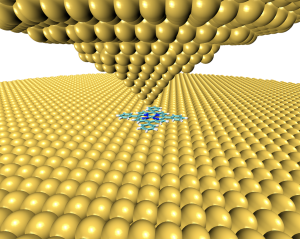 We have extended our frequency-dependent atomistic models (see 2 above) within a QM/classical formalism, for the study of the enhanced response properties/spectra of molecules perturbed by plasmonic structures in their vicinity. These computationally affordable, yet atomistic, models constitute a cornerstone for the study of phenomena such as Tip/Surface-Enhanced Raman (TERS/SERS) for the in-silico design of biosensors, among others. See J. Phys. Chem. Lett. 2025, J. Chem. Theory Comput. 2023. Our method is implemented in AMS .